Agenda Details
1. Joint Research Plan
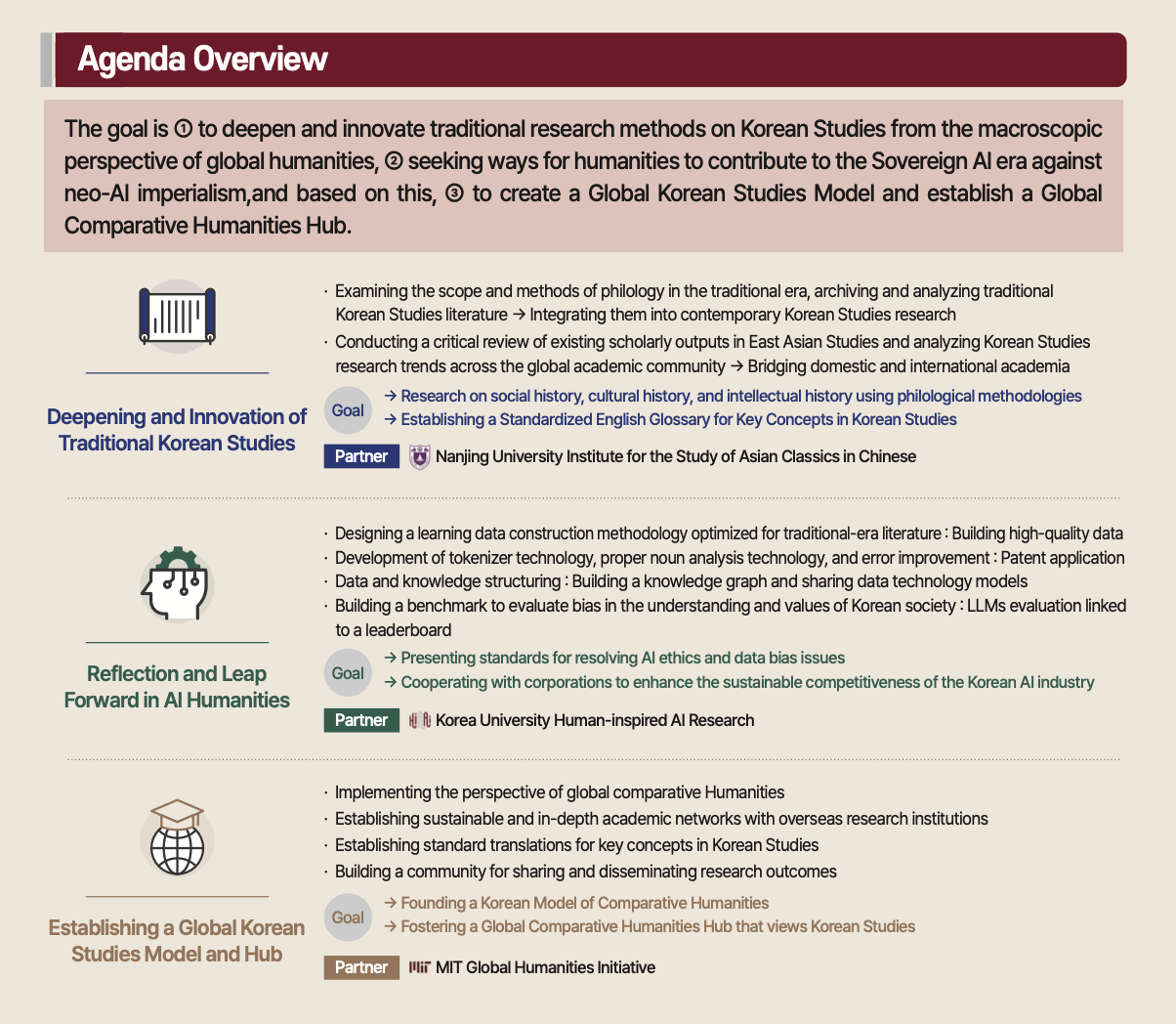
This research group aims to conduct sustained and substantive joint research with major domestic and international research institutions, as well as partners in the IT industry.
For research on Global Comparative Humanities and the establishment of a hub, the MIT Global Humanities Initiative (GHI) and the National Institute of Chinese Studies at Nanjing University will serve as core partner institutions, playing a leading role in advancing the research agenda. Additional collaborating institutions include the Institute for the Study of Japanese Classical Books at Waseda University, the Research Center for Translation and Cross-Cultural Studies at National Chengchi University, the Center for Chinese Classical Culture at Hong Kong Baptist University, the Center for Korean Studies at the University of Hawaii, and the Department of Korean Studies at the University of Tübingen.
For AI convergence research, the Human-Inspired AI (HIAI) Research Institute at Korea University will play a leading role as a core partner institution. The VR/AR-based Intelligent Life Consultant Research Center at Ajou University will participate as a cooperating institution. Furthermore, IT corporate partners, such as KT and NC AI, will join as active research partners in the interdisciplinary field of “AI and Humanities.”
For the dissemination of social outcomes and Living Lab research, affiliated organizations under Seongbuk-gu, Jongno-gu, and Dobong-gu will participate as collaborating institutions.
2. Detailed Project Plans
(1) Deepening and Innovation of Traditional Korean Studies
① Continuation and Development of Korean Philology
We will organize the methodologies of philology, which have formed the foundation of traditional Korean Humanities (hanhak), and apply them to the analysis and study of premodern texts. Building on this foundation, we will extend these methodologies to contemporary Korean Studies research.
Research Contents and Methods:
- Conduct in-depth research on the categories and methodologies of philology, including paleography, phonology, exegesis, and bibliography.
- Carry out textual organization and textual criticism of traditional Korean Studies materials.
- Examine current practices in the editing and translation of classical texts as case studies in the continuation of philological methodologies.
- Apply philosophical methodologies to research in social, cultural, and intellectual history
- Share the database developed by this research group, synthesize the findings, and publish The Philology of Korean Studies.
| Year | Research Contents | |
|---|---|---|
| Phase 1 | Year 1 | ● Study of the on categories of traditional philology, including paleography, phonology, grammar, exegesis, and bibliography. |
| Year 2 | ● Comprehensive review of methodologies for textual organization and textual criticism in traditional Korean Studies. | |
| Year 3 | ● Application of philological methodologies to premodern texts. | |
| Phase 2 | Year 1 | ● Examination of the current status Review of current practices in the editing and translation of classical texts. |
| Year 2 | ● Research on social, institutional, cultural, and intellectual history utilizing traditional philological methodologies. | |
| Year 3 | ● Database sharing and publication of The Philology of Korean Studies. |
② Reinterpretation and Expansion of Area Studies Perspectives
We will critically review existing scholarship in East Asian Studies and analyze global research trends in Korean Studies. Through this work, we aim to build a foundation that connects domestic and international academia.
Research Contents and Methods:
- Survey the academic traditions of premodern Korean Studies within the context of the East Asian Sinographic Sphere (Hanja Cultural Sphere).
- Analyze the status and research trends of Korean Studies globally, across both research and educational contexts.
- Survey the current state of pre-modern Korean Studies research in English-speaking academia and identify key academic terms.
- Propose standard English translations for these terms and publish the glossary of Korean Studies in English.
| Year | Research Contents | |
|---|---|---|
| Phase 1 | Year 1 | ● In-depth research on the history of academic and cultural exchange in premodern East Asia. |
| Year 2 | ● Research for the publication of The Formation of Overseas Korean Studies: Oral Histories of First-Generation Overseas Korean Studies Researchers (tentative title). | |
| Year 3 | ● Quantitative and qualitative analysis of research trends in the East Asian region within in domestic and international academia over the past 10 years. ● Comparative study of curricula and textbooks on traditional Korean Studies in overseas universities. ● Publication of The Present and Future of Korean Studies as Area Studies (tentative title). |
|
| Phase 2 | Year 1 | ● Survey of Korean Studies research in English-speaking academia and identification of key conceptual terms. |
| Year 2 | ● Review and standardization of English translations for key conceptual terms in Korean Studies. | |
| Year 3 | ● Publication of the glossary of Korean Studies in English. |
(2) Reflection and Advancement of AI Humanities
① Articulating the Role of Humanities for in AI
To overcome the limitations of Large Language Models (LLMs) trained on Western-centric data, we will develop evaluation tools encompassing Korean language, culture, and history. By establishing standards for selecting high-quality LLM training data, we aim to develop humanities-driven approaches to mitigate algorithmic bias.
Research Contents and Methods:
- Establish evaluation domains, item types, and criteria for Korean language, history, and culture, and construct benchmark datasets.
- Develop a benchmark specifically designed to evaluate levels of "understanding of Korea."
- Define quality evaluation standards for Korean-language texts and design LLM training datasets.
- Develop a benchmark to evaluate the value systems (alignment) of LLMs.
- Evaluate LLMs by integrating the developed benchmarks with for public leaderboard-based evaluation systems.
| Year | Research Contents | |
|---|---|---|
| Phase 1 | Year 1 | ● Conduct preliminary work for benchmark construction and finalize guidelines. |
| Year 2 | ● Construct benchmark samples based on guidelines and perform initial testing. | |
| Year 3 | ● Complete a benchmark as a "Sovereign Evaluation Tool" and conduct LLM performance evaluation experiments. | |
| Phase 2 | Year 1 | ● Conduct initial analysis/design for evaluation tool development and establish text quality standards. |
| Year 2 | ● Develop training models and evaluation tools; conduct comparative experiments based on training data quality. | |
| Year 3 | ● Develop a benchmark for value-based judgment tasks; conduct human surveys and LLM-targeted experiments. |
② AI Development for Traditional Korean Studies
We aim to transform existing literature databases into AI-readable training data and create/share technical models and Knowledge Graphs to foster a new research ecosystem.
Research Contents and Methods:
- Convert traditional literature databases into training datasets to develop Natural Language Processing (NLP) technologies capable of automated analysis.
- Enhance productivity in data construction through Distant Learning and develop technologies for tokenizers, named entity recognition (NER), and Relation Extraction models.
- Automatically construct a "Traditional Era Knowledge Graph" based on text analysis technologies.
- Foster a research ecosystem by sharing training datasets and knowledge graphs for traditional texts and explore new research topics and methodologies for the sovereign AI era.
| Year | Research Contents | |
|---|---|---|
| Phase 1 | Year 1 | ● Design methodologies for constructing tokenizer training datasets and build datasets for traditional literature. |
| Year 2 | ● Develop tokenizer technology; design methodologies and construct data for NER training. | |
| Year 3 | ● Develop NER technology, improve error rates, and file apply for patents. | |
| Phase 2 | Year 1 | ● Structure data and knowledge for Knowledge Graph construction. |
| Year 2 | ● Build Knowledge Graphs and share data/technical models. | |
| Year 3 | ● Final review of outcomes, patent filing, and exploration of new humanities research topics and methods. |
(3) Establishment of Global Korean Studies Model and Hub
① Establishing a New Model for Global Korean Studies
We aim to establish Korean Studies as a new model of area studies from the perspective of Global Humanities, positioning it as a central pillar of Global Comparative Humanities.
Research Contents and Methods:
- Analyze and research Korea’s premodern humanistic traditions through the lens of Global Comparative Humanities.
- Collaborate with domestic and international researchers to select key conceptual terms and themes in Korean Studies.
- Select contributors for major topics based on these terms and compile the Handbook of Korean Studies.
- Establish a Korean model of comparative humanities by surveying the regional and global significance of Korean Studies.
| Year | Research Contents | |
|---|---|---|
| Phase 1 | Year 1 | ● Organize the current research status of Korean Studies in Korea and the English-speaking world; select key conceptual terms and themes. |
| Year 2 | ● Select researchers (contributors) by topic for the handbook and draft initial manuscripts. | |
| Year 3 | ● Finalize and publish the Handbook of Korean Studies. | |
| Phase 2 | Year 1 | ● Conduct a comprehensive review of research methodologies in Korean Studies and Comparative Humanities. |
| Year 2 | ● Conceptualize Global Korean Studies and establish a Korean model for Comparative Humanities. | |
| Year 3 | ● Publish Korean Studies as a Regional Model of Global Comparative Humanities (tentative title). |
② Cultivating a Global Comparative Humanities Hub
We aim to build sustained and in-depth academic networks with overseas research institutions and create a research hub capable of deepening and expanding Korean Studies within the framework of Global Comparative Humanities.
Research Contents and Methods:
- Explore forms of collaboration, such as joint research, with existing international exchange institutions.
- Establish and execute concrete exchange programs with overseas organizations to expand academic networks.
- Establish a foundation for sharing the research outcomes of Global Comparative Humanities with relevant organizations worldwide.
- Cultivate a Global Comparative Humanities Hub that situates Korean Studies within a global humanistic perspective.
| Year | Research Contents | |
|---|---|---|
| Phase 1 | Year 1 | ● Discuss plans for sustainable cooperation with existing (and scheduled) partner institutions; host academic conferences and workshops. |
| Year 2 | ● Conduct exchanges and host conferences/workshops with partner institutions currently in negotiations. | |
| Year 3 | ● Formalize partnerships through MOUs and implement collaborative programs; host academic conferences and workshops. | |
| Phase 2 | Year 1 | ● Host multilateral joint academic conferences to lay the foundation for a Global Korean Studies community. |
| Year 2 | ● Build a digital online platform for sharing and disseminating research outcomes. | |
| Year 3 | ● Establish a Global Comparative Humanities community centered around this research group. |