Agenda
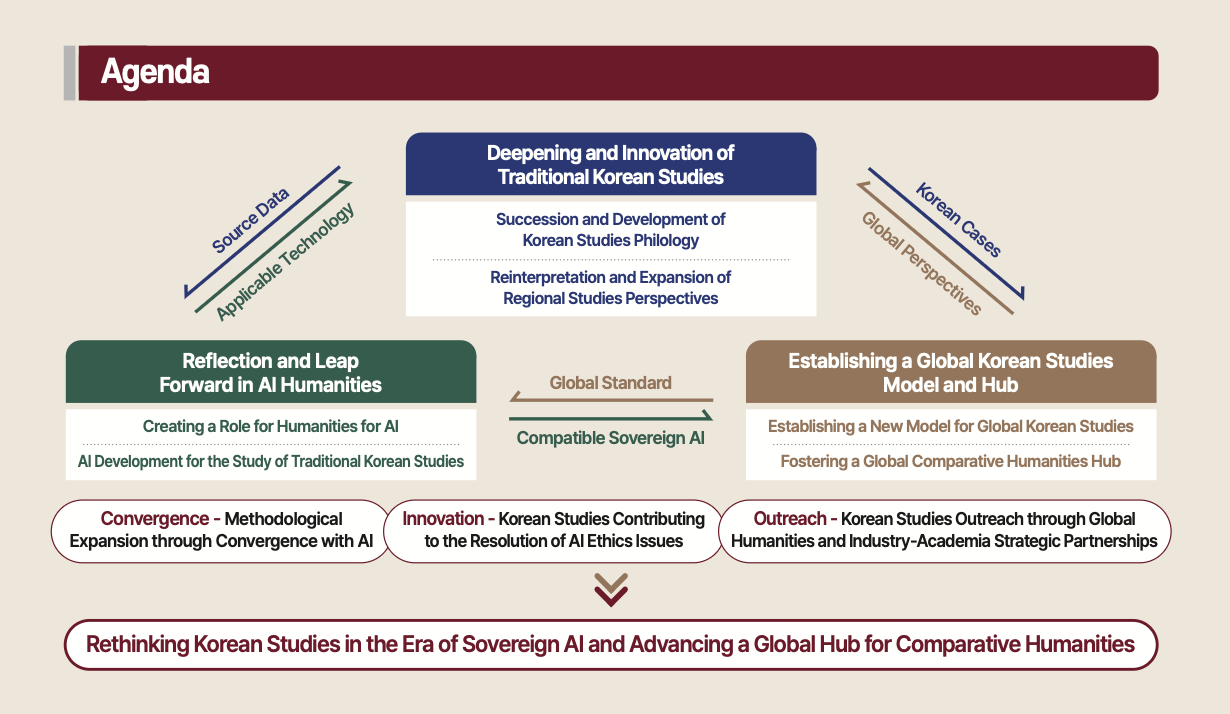
This research institute aims to:
- 1. Deepen and innovate traditional approaches in Korean Studies within the broader framework of Global Humanities;
- 2. Explore humanistic contributions to the era of Sovereign AIin response to emerging forms of AI Imperialism; and
- 3. Develop a global model for Korean Studies and establish a hub for Global Comparative Humanities.
To achieve these goals, our primary strategy is to cultivate a virtuous research ecosystem in which the advancement of traditional Korean Studies, the reflection and advancement of AI humanities, and the development of global models and hubs mutually reinforce one another.
1. Deepening and Innovation of Traditional Korean Studies
(1) Continuation and Development of Korean Philology
Philology is an complex, multi-layered field encompassing stylistics, rhetoric, and hermeneutics. It is necessary to thoroughly review the methodologies of philology, the foundation of traditional humanities, and seek ways for its productive continuation. We aim to develop philological methodologies that transcend existing perspectives in order to deepen of interpretation and a new understandings of Korean Studies materials.
(2) Reinterpretation and Expansion of Area Studies Perspectives
In line with the rise of Global Humanities, we reinterpret Korean Studies and redefine its concepts. By connecting the specificity of the Korean tradition with the universality pursued in global humanities discourse, we aim to reestablish the discourse of Korean Studies within the framework of Global Humanities. Furthermore, we propose a framework that can be shared by scholars across the global academic community, moving beyond the East Asian studies framework in both research topics and methodologies. Our goal is to advance and innovate Korean Studies as a model of area studies within the field of Global Humanities.
2. Reflection and Advancement of AI Humanities
(1) Articulating the Role of Humanities for AI
To enhance the role of humanities in the era of sovereign AI, we must move beyond the prevailing notion of simply how to utilize AI within the humanities. This research group aims to build benchmarks to measure and evaluate the biases in Large Language Models (LLMs) such as ChatGPT, which are trained on Western-centric data, and to foster the development of human-centered LLMs capable of comprehensively understanding cultural diversity, including Korean Studies. Through this research, we intend to demonstrate to industry and society that the humanities are the central actors of AI sovereignty—that is, sovereign AI—in the era of New AI Imperialism.
(2) AI Development for Traditional Korean Studies
Digital technologies capable of analyzing traditional East Asian literature remain underdeveloped. It is essential to transform existing databases, currently limited to basic search functions, into AI-ready training data, and to develop the technologies needed to analyze them. This will enable the expansion research across both temporal and spatial dimension. This research group aims to build AI training datasets for traditional Korean literature, develop technical models such as tokenizers and named entity recognition (NER), build widely accessible knowledge graphs, and develop new research methodologies based on these resources.
3. Establishment of a Global Korean Studies Model and Hub
(1) Establishing a New Model for Global Korean Studies
Global Humanities seeks to apply thousands of years of human experience from around the world to the core questions of the humanities today, granting equal value to diverse pasts, and conducting comprehensive research grounded in an awareness of complex historical roots. Together with our global partner, the MIT Global Humanities Initiative (GHI), this research group aims to establish a new standard model for Global Korean Studies and redefine the place of Korean Studies within the framework of Global Humanities through comparative research with area studies models from around the world.
(2) Creating a Global Comparative Humanities Hub
As the East Asian regional hub of the MIT Global Humanities Initiative, this research group will integrate and disseminate research results in collaboration with leading domestic and international research institutions, and establish a Global Comparative Humanities Hub that serves as a bridge among global humanities institutions. Moving beyond one-time exchanges, we will promote a shared vision of Global Humanities, build a sustainable collaborative research network, and establish ourselves as a major research hub.